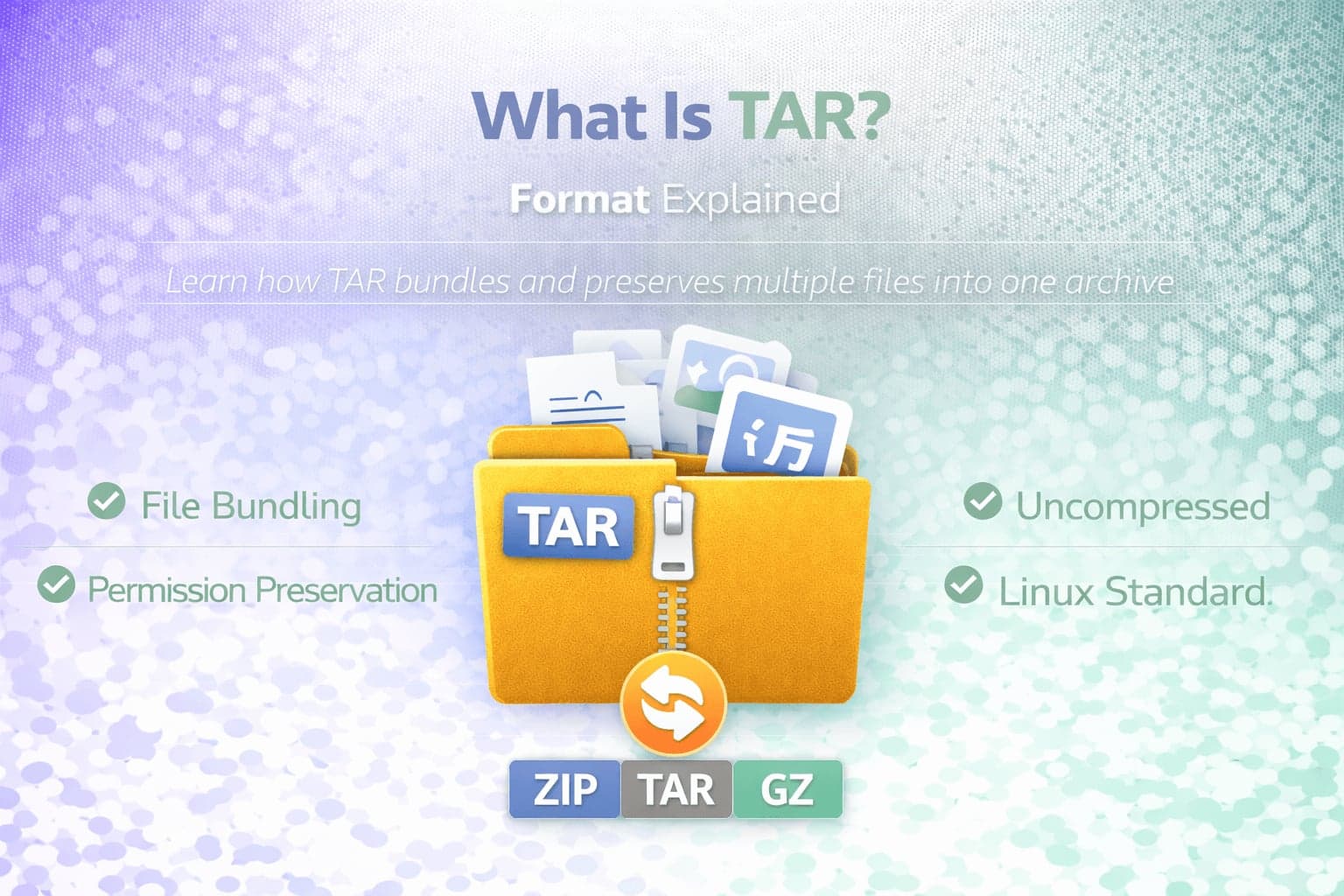
TAR is an archive file format primarily used in Unix and Linux systems to bundle multiple files and directories into a single file. Unlike ZIP, TAR does not automatically compress files. Instead, it focuses on archiving, which means grouping files together while preserving directory structure and metadata.
The name TAR stands for "Tape Archive," reflecting its original purpose of storing data on magnetic tape systems. Although modern storage technologies have evolved, the TAR format remains widely used in server environments, software distribution, and system backups.
Understanding what TAR is and how it differs from ZIP and GZ helps clarify when it should be used and why it is still common in Linux-based workflows.
What Does TAR Do?
TAR combines multiple files and folders into a single archive file, usually with the .tar extension. It preserves file structure, permissions, timestamps, and other metadata.
Unlike ZIP, TAR does not inherently reduce file size. If you create a TAR archive of files, the resulting file is roughly equal to the combined size of the original files.
Because TAR focuses on archiving rather than compression, it is often paired with separate compression tools.
TAR and Compression
On its own, TAR simply packages files together. Compression is typically added by combining TAR with a compression algorithm such as GZ. This produces files like .tar.gz, where TAR handles the archiving and GZ handles the compression.
This separation of archiving and compression provides flexibility. You can choose different compression methods while maintaining the same archive structure. If necessary, you can use our free tools to convert TAR to ZIP or convert TAR to GZ.
TAR vs ZIP
TAR and ZIP both serve as archive formats, but they operate differently.
ZIP combines archiving and compression into one format. TAR focuses primarily on archiving and relies on external compression tools when needed.
ZIP is widely used on Windows systems and is supported natively across most operating systems. TAR is commonly used in Linux and Unix environments, especially for software distribution and backups.
ZIP files often compress each file individually within the archive. TAR processes files as a continuous stream, which can sometimes improve compression efficiency when paired with GZ. If required, you can use our free ZIP to TAR converter.
TAR vs GZ
TAR and GZ are often seen together but serve different roles.
TAR is an archiving format that bundles files. GZ is a compression format that reduces file size.
When combined into a .tar.gz file, TAR packages the files and GZ compresses the entire archive.
GZ by itself usually compresses a single file, whereas TAR can contain many files and directories.
Advantages of TAR
TAR preserves file permissions and metadata accurately, which is particularly important in Linux environments.
It is efficient for packaging large software projects or entire directory structures.
Because TAR is stream-based, it works well for system-level backups and server deployments.
TAR is also widely supported in Unix-like systems and remains a standard format for distributing open-source software.
Limitations of TAR
TAR does not compress files by default. Without pairing it with a compression tool like GZ, file size remains largely unchanged.
On Windows systems, TAR may require additional tools for creation and extraction, although modern versions of Windows increasingly include native support.
For casual file sharing between general users, ZIP is often more convenient.
When Should You Use TAR?
TAR is ideal in Linux and Unix environments where preserving file permissions and directory structure is critical.
It is commonly used for system backups, server deployments, and packaging software distributions.
If compression is also required, TAR can be combined with GZ to reduce file size while maintaining structure.
When Should You Convert TAR?
Conversion may be necessary when transferring archives between Linux and Windows environments.
For example, converting TAR to ZIP can improve compatibility with Windows-based workflows. Converting TAR to GZ can apply compression if the archive is currently uncompressed.
Conclusion
TAR is an archiving format designed to bundle multiple files and directories into a single container while preserving metadata and structure.
Unlike ZIP, TAR does not compress files by default. It is often paired with compression tools such as GZ to reduce file size.
Because of its flexibility and strong integration with Unix-based systems, TAR remains a standard format for server environments, backups, and software distribution.
Understanding how TAR works and how it differs from ZIP and GZ helps ensure proper archive selection and smooth cross-platform workflows.