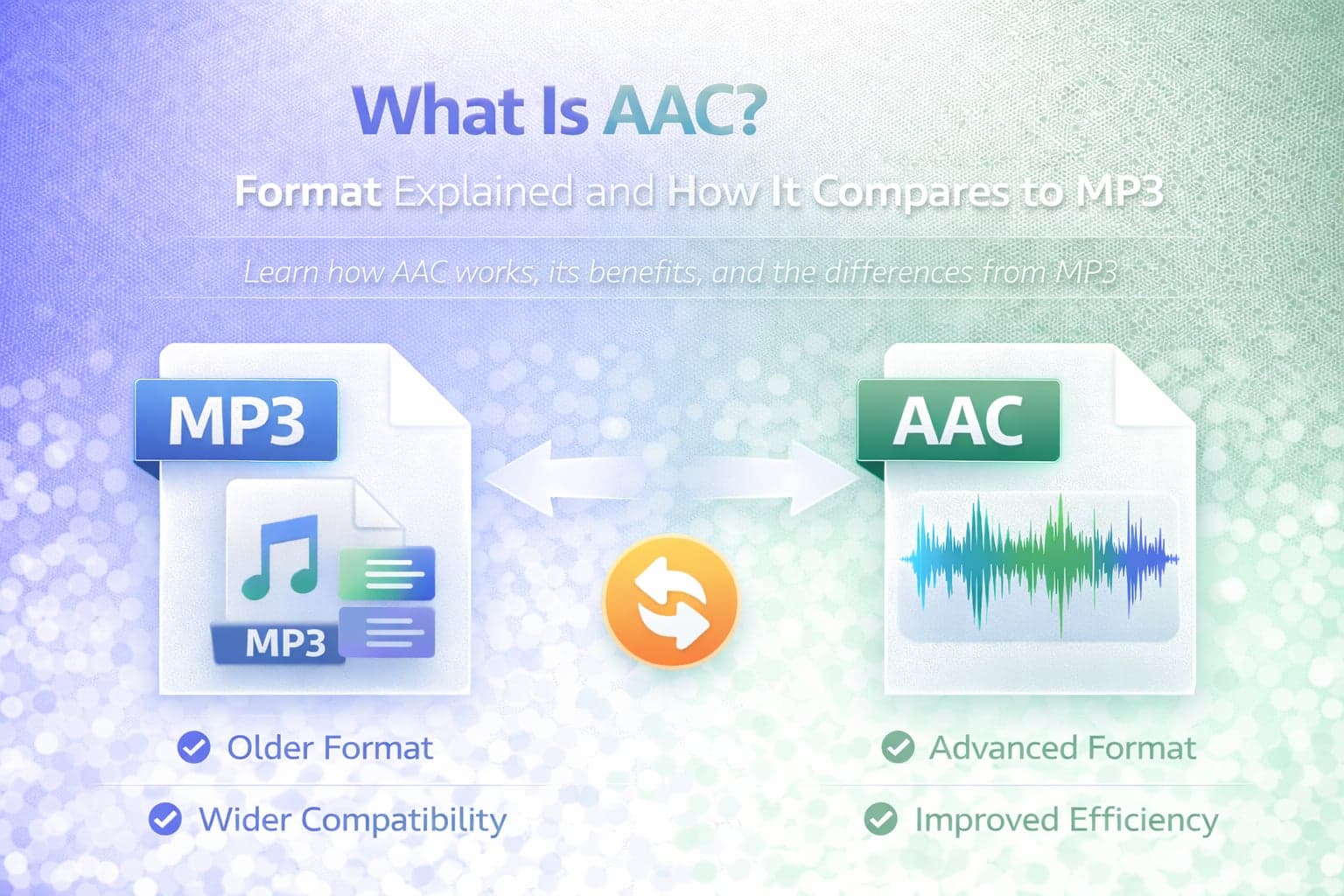
AAC is a digital audio format designed to deliver high sound quality at relatively low bitrates. It was developed as a successor to MP3 and is widely used in streaming platforms, mobile devices, and online distribution systems.
While MP3 remains one of the most recognized audio formats in the world, AAC was engineered to improve compression efficiency and overall audio performance. Understanding how AAC works and how it compares to MP3 helps clarify why certain platforms prefer it and when conversion between formats may be necessary.
AAC plays a central role in modern streaming environments, especially in ecosystems such as Apple devices and many online media services.
What Does AAC Stand For?
AAC stands for Advanced Audio Coding. It was standardized as part of the MPEG-2 and later MPEG-4 specifications.
Like MP3, AAC is a lossy compression format. However, it was developed with more advanced compression algorithms. These improvements allow AAC to achieve similar or better audio quality than MP3 at the same or lower bitrates.
Because of this efficiency, AAC often produces smaller files with comparable or improved perceived sound quality.
How AAC Compression Works
AAC uses psychoacoustic modeling similar to MP3 but with enhanced techniques. It analyzes audio signals and removes components that are less audible to human hearing.
The improvements in AAC's design allow it to encode complex sounds more efficiently. As a result, at lower bitrates, AAC may maintain clarity better than MP3.
Despite being lossy, AAC is considered more modern and technically efficient than MP3.
AAC vs MP3: The Core Differences
Both AAC and MP3 use lossy compression, but AAC was developed later and incorporates more advanced encoding methods.
At equivalent bitrates, AAC often delivers slightly better audio quality than MP3. This efficiency is one reason why many streaming services and mobile platforms adopted AAC.
MP3, however, maintains broader legacy compatibility. It is supported almost universally across devices and operating systems.
AAC is widely supported in modern systems, particularly on smartphones and streaming platforms, but older hardware may favor MP3.
If compatibility across a wide range of devices is essential, MP3 remains the safest option. If efficient compression and streaming optimization are priorities, AAC may be preferable. On FlipMyFiles, you can AAC to MP3 as well as MP3 to AAC conversion.
File Size and Bitrate Considerations
AAC's improved compression efficiency often results in smaller file sizes compared to MP3 at similar perceived quality levels.
For example, an AAC file encoded at a lower bitrate may sound comparable to a higher-bitrate MP3 file. This makes AAC attractive for streaming and mobile applications where bandwidth and storage efficiency matter.
However, differences in quality can depend on encoding settings and playback equipment.
Streaming and Platform Usage
AAC is widely used in streaming environments. Many online services and mobile platforms rely on AAC because of its efficiency and modern design.
It is particularly common in ecosystems associated with smartphones and portable devices.
MP3 continues to dominate in legacy compatibility and general file sharing.
AAC vs FLAC
AAC and FLAC represent different compression philosophies.
AAC is lossy and optimized for efficiency. FLAC is lossless and preserves all original audio information.
FLAC files are larger but maintain full fidelity. AAC files are smaller but discard some audio data.
Choosing between AAC and FLAC depends on whether storage efficiency or full preservation of detail is more important.
When Should You Use AAC?
AAC is suitable for streaming, mobile playback, and online distribution where efficient compression is important.
It is often used for podcasts, streaming services, and mobile media libraries.
If you want improved compression efficiency compared to MP3 while maintaining high compatibility on modern devices, AAC is a practical choice.
When Should You Convert AAC?
If you need broader compatibility across older devices or platforms that favor MP3, converting AAC to MP3 may be beneficial. MP3 remains more universally recognized across legacy systems.
Conclusion
AAC is a modern lossy audio format designed to improve upon MP3's compression efficiency and sound quality at lower bitrates.
While both AAC and MP3 use lossy compression, AAC generally offers better performance at similar file sizes.
MP3 remains dominant in universal compatibility. AAC is commonly preferred in streaming and mobile environments.
Understanding these differences helps clarify which format best suits your needs, whether the priority is compatibility, compression efficiency, or streaming optimization.